
Why is the red light on my G5 lower than the near-infrared?Updated 11 days ago
Short answer: the G5 is designed to put most of its power into near-infrared light, because most of what a full-body panel works on sits below the skin. Half of its LEDs are still red, and it delivers as much red light as many published studies used.
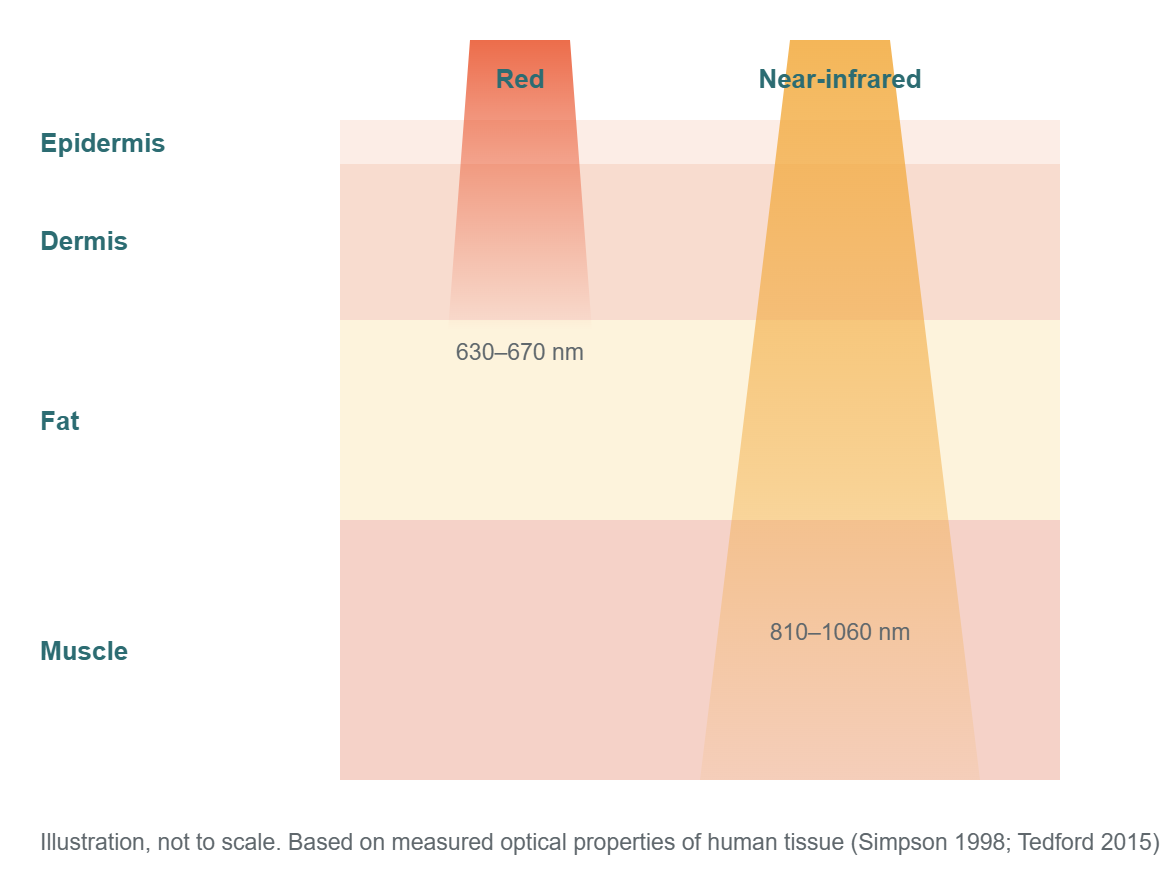
Light that goes where the work is
Red light is absorbed in the first few millimetres of skin, which makes it a natural fit for the surface. Near-infrared (NIR) light travels further. In measured human skin, fat and muscle, NIR is absorbed and scattered less than red, so more of it reaches deeper tissue.
Muscles, joints and connective tissue sit below the surface. That is why the G5's NIR channels at 810, 830, 850 and 1060 nm carry about 80% of its power. Most published muscle and joint studies used NIR in the 780–904 nm range, the same range as the G5's main NIR channels.
Half of the LEDs are red
A high share of near-infrared power does not mean a small amount of red. Exactly half of the Pro G5's LED chips are red: 288 of 576, at 630, 650, 660 and 670 nm.
| Red (630–670 nm) | Near-infrared (810–1060 nm) | |
|---|---|---|
| Share of LED chips | 50% (288 chips) | 50% (288 chips) |
| Share of light power* | about 20% | about 80% |
*Independent LightLab International test of the Pro G5, red and NIR on together.
The power split looks different from the LED count because each near-infrared chip puts out more light energy than each red chip. You get a full set of red LEDs, plus near-infrared with the power to reach deeper.
Enough red where red matters
Independent testing by LightLab International measured about 16 mW/cm² of red light at 12 inches from the Pro G5. That matches or exceeds the red intensity used in many published studies: recent at-home skin trials used about 2 to 22 mW/cm² of red.
Light therapy follows a biphasic dose response: too little light does little, and in lab studies too much can reduce the benefit. So rather than pushing red output as high as possible, we matched the G5's red light to the doses that worked in published studies. Recent home skin trials got results with about 1 to 8 J/cm² of red per session, and the G5 delivers that range in a short session at 12 inches.
| 1–8 J/cm² | Red dose per session in recent home skin trials |
| 66–126 J/cm² | Dose in older clinic studies |
| Under 10 min | For the G5 to deliver 8 J/cm² of red at 12 inches |
| 12 inches | The distance for every skin session |
Running red only for the face also fits a growing preference in the red light community for keeping strong near-infrared away from the face. Near-infrared carries most of the panel's power, so leaving it off also keeps the face from getting too warm.
What the studies say, by depth
- Muscle performance and recovery (near-infrared). Many randomized trials at 808–850 nm found better strength, endurance or recovery markers when light was used around exercise. Dose mattered, and not every trial found a benefit. Vanin 2018, review of 39 trials
- Joint comfort and mobility (near-infrared). Almost all joint studies used near-infrared. A review of 22 placebo-controlled trials found the clearest results at the doses researchers recommend. Stausholm 2019, BMJ Open
- Skin appearance (red). Home trials with red light improved the look of fine lines and skin texture at low doses. In one trial, red alone did as well as red plus near-infrared. Wunsch 2014, Photomedicine and Laser Surgery
- How deep light reaches (near-infrared). In human tissue measurements, 808 nm light passed through and spread less than 660 nm, and 830 nm reached places red did not. Tedford 2015, Lasers in Surgery and Medicine
One panel, two depths
The G5 is balanced on purpose, and the Rouge Care app adjusts the mix for each goal. The skin program runs red only (630–670 nm at 100%, near-infrared off). The muscle program leans on near-infrared (810 and 850 nm at 100%, 830 nm at 95%, 1060 nm at 65%, with red at 60–85%).
References
- Simpson 1998, Physics in Medicine and Biology. Optical properties of human skin, fat and muscle, 620–1000 nm.
- Tedford 2015, Lasers in Surgery and Medicine. Light penetration in human tissue.
- Stausholm 2019, BMJ Open. Review of 22 trials, 785–904 nm.
- Vanin 2018, Lasers in Medical Science. Review of muscle performance trials.
- LightLab International, report LLIA003053-002, Pro G5, September 2026.
- Recent home skin trials: Kim 2024; Mota 2023; Bragato 2025; Couturaud 2023.
- Older clinic studies: Russell 2005; Baez 2007.
- Huang 2009, Dose-Response. Biphasic dose response in low-level light therapy.
These are summaries of published research, not promises of specific results. Many studies used lasers or clinical devices at doses that differ from a home panel. Our products are not intended to diagnose, treat, cure, or prevent any disease.